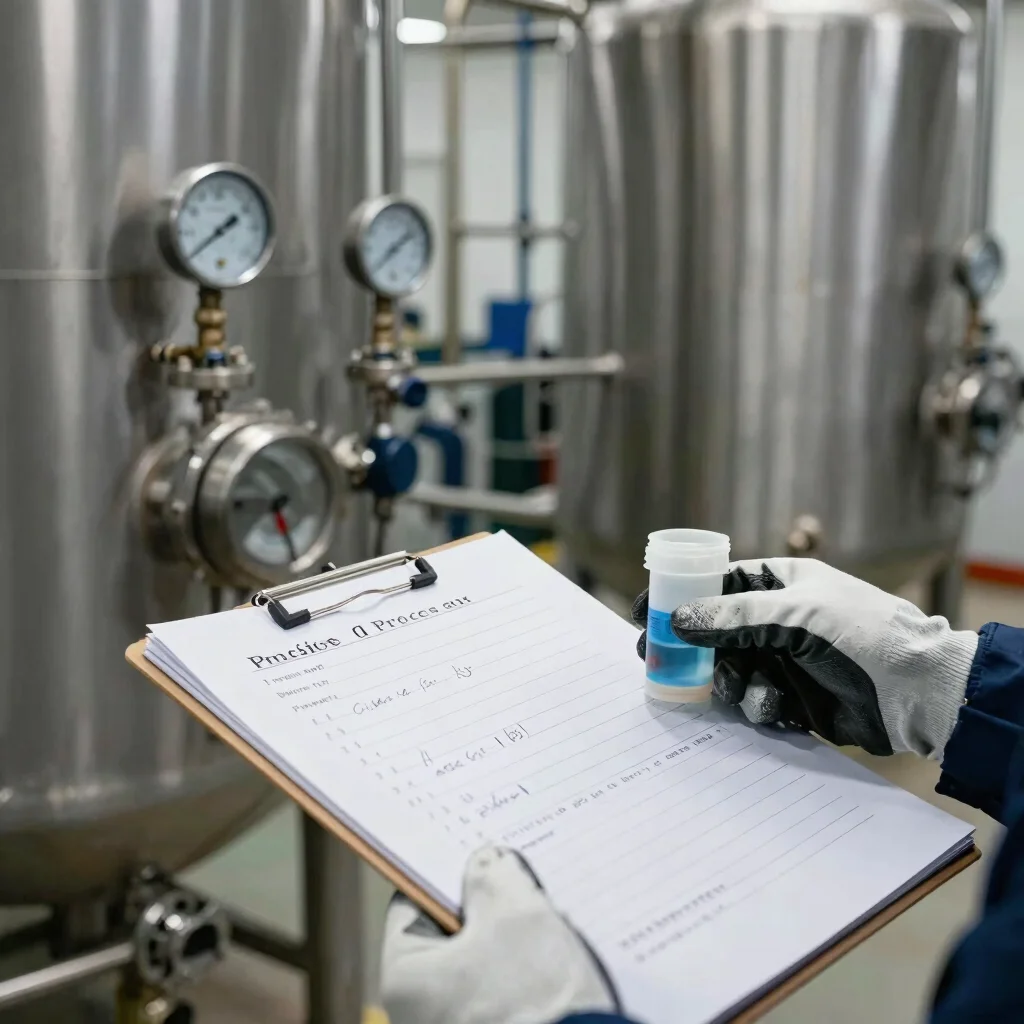
Ethanol Density: Temperature-Wise Values, Calculation, Specific Gravity and Measurement Guide
Ethanol density is an important physical property used in the alcohol, distillery, pharmaceutical, chemical, fuel and beverage industries. It helps determine the relationship between the mass and volume of ethanol and plays an important role in quality control, laboratory testing, storage, transportation and commercial transactions.
Whether you are working with Extra Neutral Alcohol (ENA), Rectified Spirit (RS), Absolute Alcohol (AA), or fuel-grade ethanol, understanding density and its relationship with temperature is essential.
In this guide, we explain ethanol density, its standard reference value, temperature-wise changes, measurement methods, calculation formulas and practical industrial applications.
1. What Is Ethanol Density?
Ethanol density is the mass of ethanol contained in a specific volume at a given temperature.
Ethanol, also known as ethyl alcohol, has the chemical formula C₂H₅OH. It is a colourless, volatile and flammable liquid widely used in industrial and commercial applications.
Density is generally expressed in:
- kg/m³ (kilograms per cubic metre)
- kg/L (kilograms per litre)
- g/cm³ (grams per cubic centimetre)
The density of pure ethanol at 20°C is approximately 789.3 kg/m³, equivalent to 0.7893 kg/L or 0.7893 g/cm³.
This value applies to nearly pure ethanol under the specified reference conditions. Commercial ethanol products containing water or other components may have different density values.
2. Standard Density of Pure Ethanol
The density of pure ethanol changes with temperature. As temperature increases, ethanol generally expands and its density decreases.
| Parameter | Approximate value |
|---|---|
| Chemical name | Ethanol / Ethyl Alcohol |
| Chemical formula | C₂H₅OH |
| Molecular weight | 46.07 g/mol |
| Density at 20°C | 789.3 kg/m³ |
| Density at 20°C | 0.7893 kg/L |
| Density at 20°C | 0.7893 g/cm³ |
| Boiling point | Approximately 78.4°C |
| Freezing point | Approximately -114°C |
| Appearance | Colourless liquid |
Important: The reference density of pure ethanol should not be confused with the density of an ethanol-water mixture or a commercial alcohol product.
3. Ethanol Density at Different Temperatures
Temperature has a direct impact on ethanol density. The following table provides approximate density values for pure ethanol at atmospheric pressure.
| Temperature | Density (kg/m³) | Density (kg/L) |
|---|---|---|
| 0°C | 806.4 | 0.8064 |
| 5°C | 802.2 | 0.8022 |
| 10°C | 797.9 | 0.7979 |
| 15°C | 793.7 | 0.7937 |
| 20°C | 789.4 | 0.7894 |
| 25°C | 785.1 | 0.7851 |
| 30°C | 780.8 | 0.7808 |
| 35°C | 776.5 | 0.7765 |
| 40°C | 772.1 | 0.7721 |
These values are approximate reference values for pure ethanol, not a temperature-correction table for every commercial alcohol grade.
For precise industrial measurements, use the applicable certified reference tables and the actual product composition.
4. Why Does Ethanol Density Change with Temperature?
Ethanol expands when heated and contracts when cooled.
When the temperature increases:
- The volume of ethanol increases.
- Its mass remains approximately constant in a closed system.
- Its density decreases.
When the temperature decreases:
- The volume of ethanol decreases.
- Its density increases.
This relationship is particularly important in distilleries and ethanol storage facilities, where liquid temperature may change during production, tank storage, loading and transportation.
5. Formula for Calculating Ethanol Density
Density is calculated by dividing the mass of a substance by its volume.
Formula:
Density = Mass ÷ Volume
Where:
- Density = kg/L or kg/m³
- Mass = kg
- Volume = L or m³
For example:
Suppose a sample of ethanol has:
- Mass = 7.893 kg
- Volume = 10 litres
Density = 7.893 ÷ 10
Density = 0.7893 kg/L
Therefore, the calculated density is 789.3 kg/m³.
6. Difference Between Ethanol Density and Specific Gravity
Density and specific gravity are related but are not the same measurement.
| Parameter | Density | Specific Gravity |
|---|---|---|
| Meaning | Mass per unit volume | Ratio of two densities |
| Unit | kg/m³, kg/L | No unit |
| Reference | Specified temperature | Reference substance and temperature |
| Application | Mass-volume calculations | Relative density comparison |
Specific gravity is commonly calculated by comparing the density of a liquid with the density of water at specified reference temperatures.
Always mention the reference temperature when reporting specific gravity.
7. How Is Ethanol Density Measured?
Ethanol density can be determined using different laboratory instruments and methods.
1. Digital Density Meter
A digital density meter is commonly used for accurate laboratory measurement. It measures the density of a liquid using an oscillating U-tube principle.
2. Hydrometer
A hydrometer measures the relative density or, in the case of an alcohol hydrometer, may indicate alcoholic strength or density directly.
The instrument must be suitable for the liquid being tested, and the reading must be interpreted at the correct temperature.
3. Pycnometer
A pycnometer is a calibrated glass vessel used to determine density by measuring the mass of a known volume of liquid.
4. Laboratory Analytical Method
Laboratories may use standardised analytical procedures, calibrated balances, temperature-controlled equipment and recognised alcoholometric tables.
8. Importance of Ethanol Density in Distilleries
Ethanol density is an important quality-control parameter in grain-based and molasses-based distilleries.
Its applications include:
- Monitoring the quality of Rectified Spirit (RS).
- Checking Extra Neutral Alcohol (ENA) specifications.
- Monitoring fuel ethanol quality.
- Supporting laboratory analysis and product verification.
- Estimating liquid inventory in storage tanks.
- Supporting mass and volume reconciliation.
- Monitoring product consistency during dispatch.
- Checking temperature-related variations during transportation.
However, density alone cannot establish the complete quality or purity of ethanol. Other tests, including alcoholic strength, water content, acidity, aldehydes, methanol and other applicable parameters, may also be required.
9. Difference Between Pure Ethanol and Ethanol-Water Mixtures
One important point is that pure ethanol and ethanol mixed with water do not have the same density.
When ethanol and water are mixed, the total volume is not necessarily equal to the sum of their individual volumes. This phenomenon is known as volume contraction.
Therefore, the density of an ethanol-water mixture depends on:
- Ethanol concentration.
- Water concentration.
- Measurement temperature.
- Reference conditions.
For this reason, the density of an ethanol-water mixture must be determined using recognised alcoholometric tables rather than simply applying the density of pure ethanol.
The International Organization of Legal Metrology (OIML) publishes international alcoholometric tables for determining density and alcoholic strength of ethanol-water mixtures.
10. Frequently Asked Questions (FAQs)
Q1. What is the density of pure ethanol at 20°C?
The density of pure ethanol at 20°C is approximately 789.3 kg/m³ or 0.7893 kg/L.
Q2. What is the density of ethanol in kg/L?
Pure ethanol has an approximate density of 0.7893 kg/L at 20°C.
Q3. Does ethanol density increase or decrease with temperature?
Ethanol density generally decreases as temperature increases because the liquid expands.
Q4. What is the density of ethanol at 25°C?
The approximate density of pure ethanol at 25°C is 785.1 kg/m³ or 0.7851 kg/L.
Q5. What instrument is used to measure ethanol density?
Digital density meters, suitable hydrometers and pycnometers are commonly used to determine ethanol density.
Q6. Is ethanol density the same as specific gravity?
No. Density is expressed as mass per unit volume, whereas specific gravity is a dimensionless ratio comparing the density of a substance with that of a reference substance.
Q7. Why is ethanol density important in a distillery?
It helps with laboratory quality control, product monitoring, inventory calculations, storage management and commercial measurement.
Q8. Is the density of ENA the same as pure ethanol?
No. ENA is an ethanol product that may contain a small quantity of water and other permitted constituents. Its measured density depends on its composition and temperature.
Q9. Can ethanol density be used to determine alcohol percentage?
Yes, the density of an ethanol-water mixture can be used with recognised alcoholometric tables to determine alcoholic strength under the applicable measurement conditions. Other components can interfere with this relationship.
Q10. What is the standard reference temperature for alcoholometric measurements?
20°C is the internationally recognised reference temperature used in OIML alcoholometric tables.
Conclusion
Ethanol density is an important parameter for understanding the physical properties and commercial measurement of alcohol. Temperature, concentration and composition all influence the measured density.
For accurate industrial and laboratory applications, it is essential to maintain proper temperature control, use calibrated measuring instruments and follow recognised standards.
Understanding ethanol density helps distillery professionals, laboratory chemists, quality-control teams and ethanol manufacturers improve measurement accuracy and product monitoring.
Reference: International Organization of Legal Metrology (OIML), International Alcoholometric Tables (R 22); International Organisation of Vine and Wine (OIV), methods of analysis for alcohol and spirituous beverages.