How Can Ethanol and Ethanoic Acid Be Differentiated on the Basis of Their Physical and Chemical Properties?
Ethanol and ethanoic acid are two important organic compounds commonly studied in chemistry. Both contain carbon, hydrogen and oxygen atoms, but they have different chemical structures, functional groups and properties.
Ethanol is an alcohol widely used as a solvent, fuel and industrial raw material, whereas ethanoic acid is a carboxylic acid commonly known as acetic acid, which is the main acid present in vinegar.
Although both compounds are colourless liquids under ordinary conditions, they can be differentiated through their physical and chemical properties.
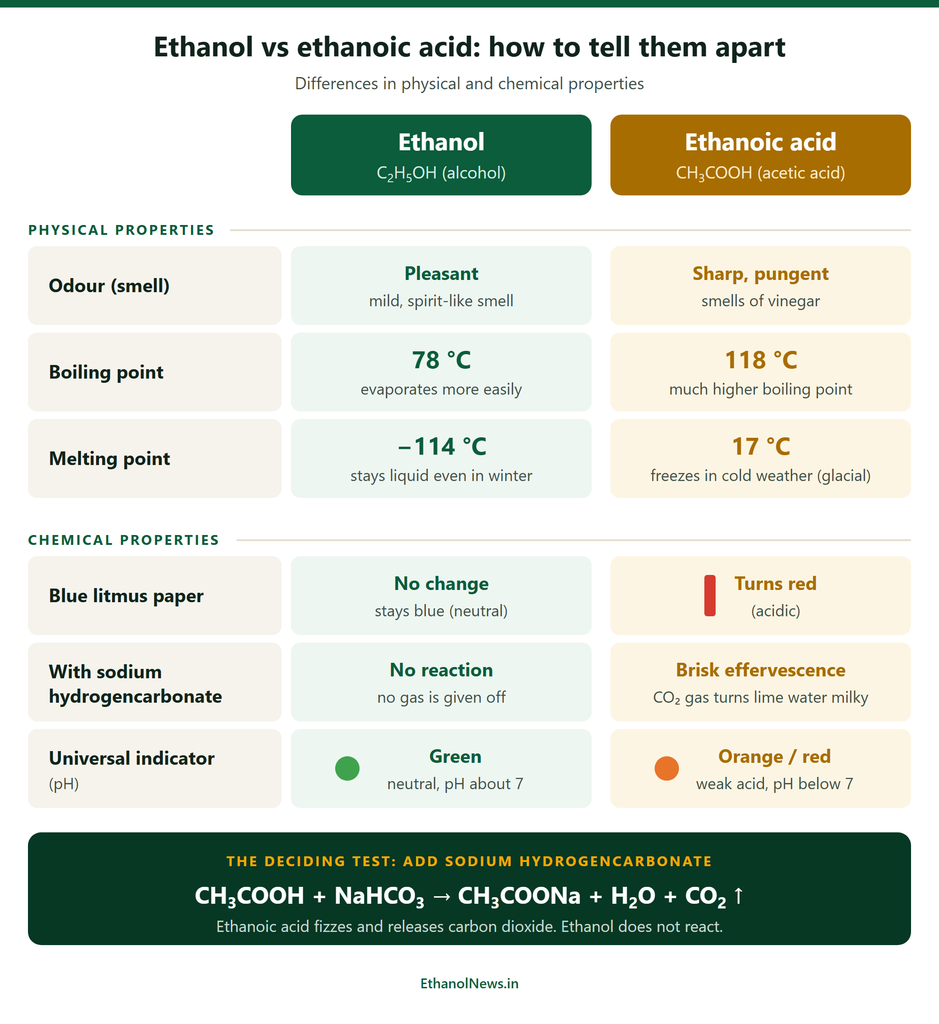
In this article, we explain the differences between ethanol and ethanoic acid using simple examples, comparison tables, chemical equations and laboratory identification tests.
1. What Is Ethanol?
Ethanol, also known as ethyl alcohol, is an organic compound with the molecular formula C₂H₅OH.
It belongs to the alcohol family and contains a hydroxyl functional group (-OH) attached to a carbon atom.
Basic properties of ethanol:
- Chemical name: Ethanol
- Common name: Ethyl alcohol
- Molecular formula: C₂H₅OH
- Molecular weight: 46.07 g/mol
- Functional group: Hydroxyl (-OH)
- Nature: Nearly neutral in aqueous solution
- Boiling point: Approximately 78.4°C
- Appearance: Colourless liquid
- Solubility: Completely miscible with water
Ethanol is used in pharmaceutical products, sanitizers, cosmetics, chemical manufacturing and fuel applications.
2. What Is Ethanoic Acid?
Ethanoic acid, also known as acetic acid, is an organic compound with the molecular formula CH₃COOH.
It belongs to the carboxylic acid family and contains a carboxyl functional group (-COOH).
Basic properties of ethanoic acid:
- Chemical name: Ethanoic acid
- Common name: Acetic acid
- Molecular formula: CH₃COOH
- Molecular weight: 60.05 g/mol
- Functional group: Carboxyl (-COOH)
- Nature: Weak acid
- Melting point: Approximately 16.6°C
- Boiling point: Approximately 118°C
- Appearance: Colourless liquid
- Solubility: Completely miscible with water
Ethanoic acid is used in vinegar, food processing, chemical manufacturing, textile industries and other industrial applications.
3. Difference Between Ethanol and Ethanoic Acid on the Basis of Physical Properties
Ethanol and ethanoic acid can be differentiated by comparing their physical properties, including boiling point, melting point, density, smell and molecular weight.
| Physical property | Ethanol | Ethanoic acid |
|---|---|---|
| Chemical formula | C₂H₅OH | CH₃COOH |
| Molecular weight | 46.07 g/mol | 60.05 g/mol |
| Functional group | -OH | -COOH |
| Physical state at room temperature | Liquid | Liquid |
| Appearance | Colourless | Colourless |
| Boiling point | 78.4°C | 118°C |
| Melting point | -114°C | 16.6°C |
| Density at approximately 20°C | 0.789 g/cm³ | 1.049 g/cm³ |
| Smell | Characteristic alcoholic smell | Sharp, vinegar-like smell |
| Solubility in water | Completely miscible | Completely miscible |
Important observation: Ethanoic acid has a higher boiling point than ethanol because of stronger intermolecular hydrogen bonding and the association of carboxylic acid molecules.
Pure ethanoic acid can freeze near 16.6°C. It is therefore sometimes called glacial acetic acid when found in its concentrated, solid or ice-like form.
4. Difference Between Ethanol and Ethanoic Acid on the Basis of Chemical Properties
The most reliable way to differentiate ethanol and ethanoic acid is through their chemical reactions.
A. Reaction with Sodium Bicarbonate (NaHCO₃)
This is one of the simplest laboratory tests for distinguishing ethanol from ethanoic acid.
Ethanol:
Ethanol does not produce carbon dioxide gas when treated with sodium bicarbonate under ordinary laboratory conditions.
Ethanoic acid:
Ethanoic acid reacts with sodium bicarbonate to produce carbon dioxide gas, water and sodium acetate.
Chemical equation:
CH₃COOH + NaHCO₃ → CH₃COONa + H₂O + CO₂↑
Observation:
- Ethanol: No noticeable effervescence.
- Ethanoic acid: Brisk effervescence due to the release of carbon dioxide gas.
This reaction is a useful chemical test for identifying ethanoic acid.
B. Reaction with Blue Litmus Paper
The two compounds can also be distinguished using blue litmus paper.
Ethanol:
Ethanol does not change blue litmus paper under ordinary conditions.
Ethanoic acid:
Ethanoic acid turns blue litmus paper red because it is an acid.
Observation:
| Compound | Effect on blue litmus |
|---|---|
| Ethanol | No colour change |
| Ethanoic acid | Turns red |
C. Reaction with Sodium Metal
Both ethanol and ethanoic acid react with sodium metal and release hydrogen gas. However, this is not the preferred simple identification test.
Reaction with ethanol:
2C₂H₅OH + 2Na → 2C₂H₅ONa + H₂↑
Product: Sodium ethoxide and hydrogen gas.
Reaction with ethanoic acid:
2CH₃COOH + 2Na → 2CH₃COONa + H₂↑
Product: Sodium acetate and hydrogen gas.
Ethanoic acid generally reacts more readily with sodium than ethanol because it is more acidic.
This experiment should only be performed by trained personnel using appropriate laboratory safety precautions because sodium reacts vigorously and hydrogen is flammable.
D. Oxidation Reaction
Ethanol can be oxidised to ethanoic acid using suitable oxidising agents such as acidified potassium dichromate or alkaline potassium permanganate under appropriate conditions.
Chemical equation:
CH₃CH₂OH + 2[O] → CH₃COOH + H₂O
Observation:
When acidified potassium dichromate is used, its colour changes from orange to green as the ethanol is oxidised.
Ethanoic acid is already in a more highly oxidised state and does not undergo the same oxidation to ethanoic acid.
5. Comparison of Chemical Reactions
| Chemical test | Ethanol | Ethanoic acid |
|---|---|---|
| Blue litmus test | No change | Turns blue litmus red |
| Sodium bicarbonate test | No CO₂ evolution | Produces CO₂ bubbles |
| Sodium metal test | Releases hydrogen | Releases hydrogen |
| Oxidation | Can form ethanoic acid | Does not undergo the same oxidation |
| Nature | Alcohol | Weak organic acid |
6. Which Is the Best Test to Differentiate Ethanol and Ethanoic Acid?
The sodium bicarbonate test is a simple and reliable way to distinguish ethanol from ethanoic acid.
Take separate small samples in suitable laboratory test tubes and add a little sodium bicarbonate to each.
- If bubbles of carbon dioxide are produced, the sample contains an acid such as ethanoic acid.
- If there is no noticeable reaction, the sample may be ethanol.
The blue litmus test provides an additional simple confirmation.
These tests should be performed using properly labelled samples and standard laboratory safety procedures.
7. Why Are Ethanol and Ethanoic Acid Different?
The main reason for the difference is their functional groups.
Ethanol contains the hydroxyl group (-OH), while ethanoic acid contains the carboxyl group (-COOH).
The carboxyl group allows ethanoic acid to release hydrogen ions in aqueous solution, making it acidic.
Ethanol does not show the same acidic behaviour in ordinary aqueous conditions.
Therefore, their functional groups determine many of their physical and chemical properties.
8. Frequently Asked Questions (FAQs)
Q1. What is the main difference between ethanol and ethanoic acid?
Ethanol is an alcohol with the formula C₂H₅OH, whereas ethanoic acid is a carboxylic acid with the formula CH₃COOH.
Q2. How can ethanol and ethanoic acid be differentiated chemically?
They can be differentiated using sodium bicarbonate. Ethanoic acid produces carbon dioxide bubbles, whereas ethanol does not show this reaction.
Q3. Which compound turns blue litmus red?
Ethanoic acid turns blue litmus red because it is acidic. Ethanol does not change blue litmus under ordinary conditions.
Q4. Which has a higher boiling point, ethanol or ethanoic acid?
Ethanoic acid has a higher boiling point, approximately 118°C, compared with ethanol at approximately 78.4°C.
Q5. Why does ethanoic acid react with sodium bicarbonate?
Ethanoic acid reacts with sodium bicarbonate because it is an acid. The reaction releases carbon dioxide gas, water and sodium acetate.
Q6. What happens when ethanol is oxidised?
Ethanol can be oxidised to ethanoic acid using suitable oxidising agents under appropriate conditions.
Q7. Are ethanol and ethanoic acid soluble in water?
Yes. Both ethanol and ethanoic acid are completely miscible with water.
Q8. Which compound is present in vinegar?
Ethanoic acid, also known as acetic acid, is the acid present in vinegar.
Q9. What are the functional groups of ethanol and ethanoic acid?
Ethanol contains a hydroxyl group (-OH), while ethanoic acid contains a carboxyl group (-COOH).
Q10. Can both ethanol and ethanoic acid react with sodium metal?
Yes. Both react with sodium metal to release hydrogen gas, but the reactions differ in their products and relative reactivity.
Conclusion
Ethanol and ethanoic acid are two different organic compounds with different functional groups and chemical properties.
Ethanol is an alcohol, while ethanoic acid is a weak organic acid. They can be differentiated through their boiling points, melting points, reactions with sodium bicarbonate and effects on blue litmus paper.
The sodium bicarbonate test is particularly useful because ethanoic acid releases carbon dioxide gas, while ethanol does not produce this reaction.
Understanding these differences helps students develop a better understanding of organic chemistry, functional groups and chemical reactions.